

A recent national survey reveals that more than 20% of urban households in India reside in apartment complexes, representing millions of current and future EV users who cannot set up personal chargers like those in independent homes. For these residents, charging depends entirely on the readiness and willingness of shared housing societies—creating a significant gap in accessible EV infrastructure.
With nearly 80% of EV charging traditionally occurring at home, the absence of safe and convenient residential charging in high-rise communities is rapidly becoming one of the biggest barriers to EV adoption. Most apartment societies remain unprepared, often restricting installations due to safety, load limitations, or outdated wiring.
EV infrastructure developers—especially those focused on Electrical Safety — this presents a massive opportunity. As residential charging challenges grow, demand is shifting toward centralized, high-speed, pay-per-use charging hubs within or near apartment clusters.
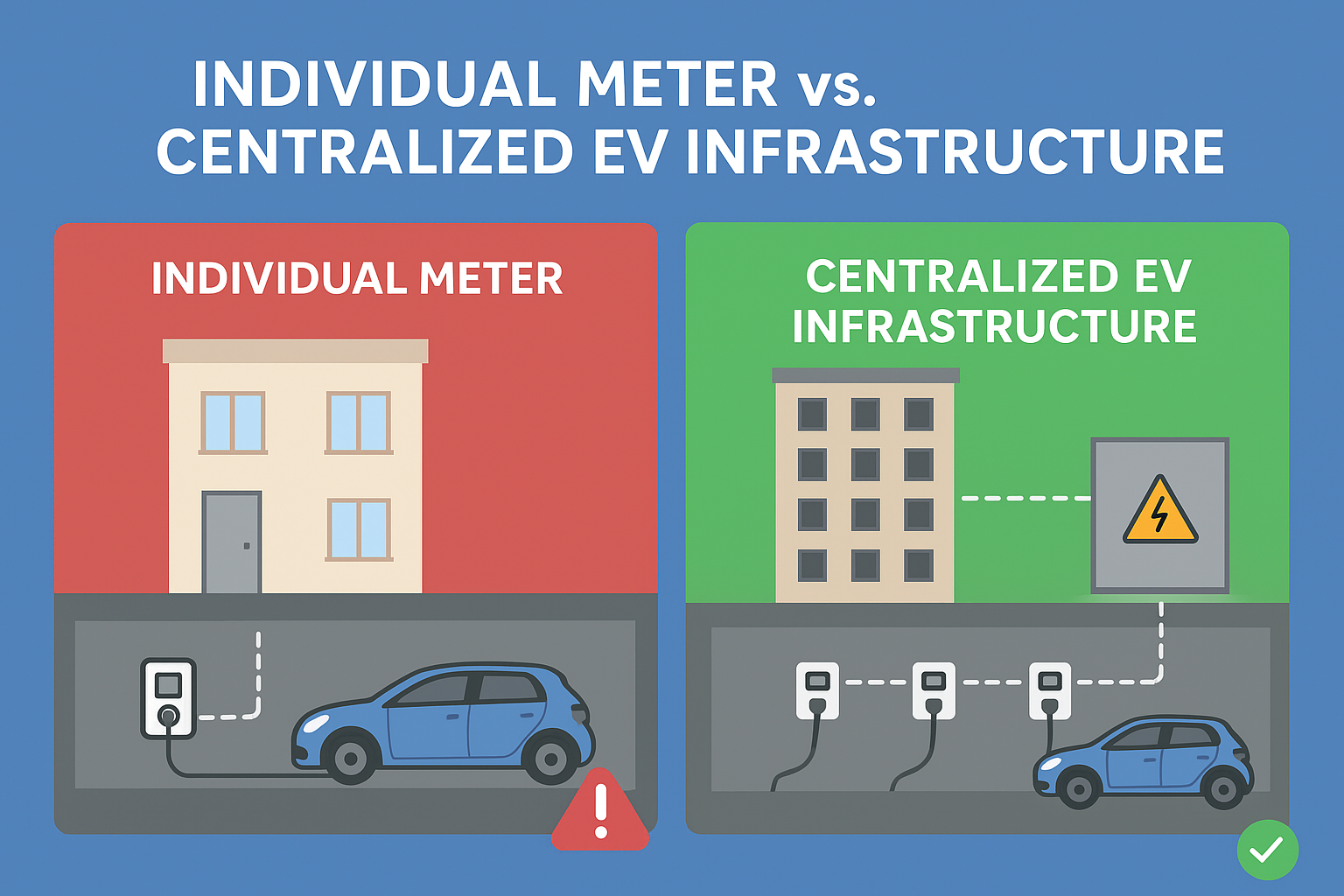
Below is a clean, concise comparative table highlighting the key differences between Individual Meter EV Charging Connections and Centralized EV Charging Infrastructure — especially useful for RWA, DISCOM, and building management presentations.
Comparative Table: Individual Meter vs. Centralized EV Charging Infrastructure
| Parameter | Individual Meter Connection (AC Chargers in Basement) | Centralized EV Charging Infrastructure (Common Load / EV Hub) |
|---|---|---|
| Safety Compliance | Often non-compliant with NBC (National Building Code), Fire Dept., and DISCOM norms | Fully compliant with EV charging standards & safety codes |
| Wiring Method | Long cable runs from apartment meter to basement; unsafe routing | Dedicated EV wiring, fire-rated cables, proper containment |
| Fire Risk | Higher due to cable overloading, poor earthing, and confined basement heat | Lower due to certified equipment, controlled environment, and protection systems |
| Load Management | No load balancing; each user draws uncontrolled power from flat meter | Central load management with smart meters, balancing, and monitoring |
| Impact on Building Electrical System | Can overload LT panels/transformers; nuisance tripping | Dedicated sanctioned load protects building electrical infra |
| Installation Quality | Typically done by local electricians; inconsistent standards | Professionally engineered and installed by EV infra experts |
| Space Utilization | Chargers scattered across parking; wiring clutter | Organized EV charging bay with structured layout |
| Scalability | Limited; each new user adds complexity and safety risks | Easily expandable with modular chargers and panel capacity |
| User Convenience | Individual cost goes to personal meter; no central system control | Smart billing, app-based control, 24×7 monitored service |
| Charging Speed | Mostly slow chargers | AC + DC options (7.4 kW to 60 kW) depending on need |
| Energy Monitoring | No centralized visibility; hard to calculate total EV load | Central dashboard with usage, energy flow, faults, and alerts |
| Maintenance | User-dependent; no standardized O&M | Central O&M ensures uptime and safety compliance |
| Cost Efficiency | Higher per-user cost due to individual wiring and installation | Lower overall cost due to shared infra and economies of scale |
| Future Readiness | Difficult to upgrade; wiring limitations | Fully future-proof with smart chargers and EV-ready design |
| Approval Process | Often bypassed; leads to potential penalties from DISCOM/fire dept | Fully approved by DISCOM, Electrical Inspector, and RWA |
At VN Global Enterprises, we specialize in delivering end-to-end EV charging infrastructure that is safe, reliable, and future-ready for urban residential communities, commercial spaces, and fleet operators. From technical design and electrical approvals to installation, operations, and maintenance, our solutions are compliant with national standards and trusted by leading government and private organizations. If you are planning to upgrade your premises with EV charging facilities or need expert guidance on the right infrastructure model, we’re here to support you every step of the way.
Contact us at +91 93983 31107 or email [email protected] to get started.